Centrifugal fans are among the most important components of industrial mixing and pumping systems . They are widely used in the chemical, water treatment, food, and pharmaceutical industries and generate an airflow perpendicular to the rotation axis. This article describes their design, performance, advantages, and applications.
What is radial motivation?
The radial rotor is an industrial motor with the following properties:
-
They generate an outflow at a 90-degree angle to the axis.
-
Generates high pressure and medium flow.
-
Suitable for low and medium viscosity liquids (less than 50,000 cP)
Main types of radial helicopters
-
Turbine thrust
-
4-6 bed sheets
-
Suitable for intensive mixing.
-
-
straight blade
-
The simplest design
-
Application in centrifugal pumps
-
-
curved blade
-
higher efficiency
-
Reduce flow disturbances
-
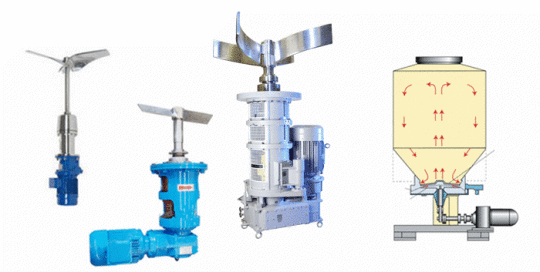
Functional principles and design
Mechanism of action
-
The rotation of the impeller transfers kinetic energy to the liquid .
-
The centrifugal force pushes the liquid radially outwards.
-
A vortex pattern forms .
Main design parameters
| reach | Optimal range | Impact on performance |
|---|---|---|
| Impeller diameter | 30-50% of the tank diameter | Increase in driving force |
| Number of blades | 4-6 pieces | Balance between power and chaos |
| Blade angle | 75-90 degrees | Improve churn |
| speed | 50-400 rpm | Control the mixing intensity |
Advantages of the radial impeller
-
High efficiency and mixing density
-
Ability to work with low viscosity liquids.
-
Generate a high shear force (important for emulsification)
-
Simple design and easy maintenance.
-
Flexible configuration of flow patterns
Industrial application
1. Chemical industry
-
Hybrid reactor
-
Catalyst Commentary
2. Water and wastewater treatment
-
Ventilation of the expansion tank
-
mixed coagulant
3. Food industry
-
Homogenization of milk and dairy products
-
Production of sauces and emulsions
4. Pharmaceutical industry
-
Sterile solution mixture
-
Active ingredient suspension
How to choose the right bow tie
Factors influencing the election
-
Viscosity of liquids
-
Required type of mixing process
-
Tank size
-
Energy restrictions
Basic formula
-
Reynolds number (Re) :
(ρND²)/μ -
Power (Po) :
P/(ρN³D⁵) -
Pump power (Q) :
NQND³
Problems and solutions
Frequently Asked Questions
-
High-speed cavitation
-
Uneven mixing in large tanks
-
Blade wear in corrosive environments
Solutions to improve
-
Use of corrosion-resistant materials (SS316, Hastelloy)
-
Use barriers to improve flow patterns.
-
Adjust the speed to the viscosity .
Comparison table with other butterflies
| Special feature | radial flow | axial flow | mixed flow |
|---|---|---|---|
| flow chart | perpendicular to the axis | parallel axis | Connection |
| Outlet pressure | higher | half | Medium to high |
| Applied viscosity | Low to medium | A little | All types |
| Energy consumption | half | A little | half |
Maintenance and repair
-
Regularly check the fan balance
-
Check the bearing clearance
-
Quick replacement of seals and closures
-
Clean deposits regularly.
Finally
Centrifugal fans play a key role in the process industry due to their high efficiency and design flexibility . Selecting the appropriate fan type based on the working fluid properties and process requirements can improve efficiency and reduce operating costs .
Frequently Asked Questions
1. What are the main differences between radial and axial impellers?
Radial impellers generate a flow perpendicular to the axis, while axial impellers generate a flow parallel to it.
2. Can these stirrers be used for very thick liquids?
No, for liquids with high viscosity (over 50,000 cP) a bevel gear motor is best suited.
3. What is the average lifespan of these butterflies?
Depending on the type of license and working conditions, 3 to 7 years.
4. What are the most important design criteria for these fans?
-
ISO 2858 Centrifugal pumps
-
Material standard: ASME B73.1.
Keywords: radial fan, industrial motor, fan design, industrial mixing, centrifugal pump